Mohamed Abbas Omar
Sunday, April 15, 2007
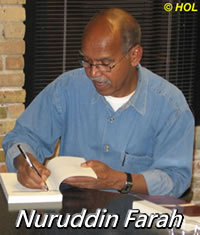 Together with other prominent world writhers such as Chinua Achebe, Wole Soyinka, Ngugi Wa Thiong’o, Alice Munro, Toni Morrism, David Malouf, and Isabel Allende, Nuruddin Farah has always been one of my most favourite writers when it comes to English novels. He is, indeed, an undisputed international literary icon and an intellectual ambassador who has never forgotten his homeland
Recently, I was in Kinokuniya, a leading bookshop that is located in
Finally and after a careful thought of my own, I realized that one cannot build factual criticism based on what someone says about another person, particularly when you are not aware the intention of the latter. But whatever the case is, Nuruddin Farah’s comments on the Hijab were very upsetting, and like any other Muslim, I was very distressed.
But contrary to the assumption of what many people believe about Nurudddin Farah’s style of writing, it is fair to note that Islam has made a significant influence in Nuruddin Farah’s writings. For instance, in the novel, “Close Sesame”, although it is about
“His watch advised him that it was time to say a small prayer or two. One prayer led to another. One prostration suggested a second and a third. O my Lord, great Thou art without a doubt, the greatest and most merciful and most compassionate; welcome us, O Lord, allow us into the enclosure Thou art in, permit us to enter Thy dwelling in tranquil peace. For Thou art a celebration and we, with every breath we receive or emit, are mere manifestations of Thy existence. And Thou art our closest neighbour, our protector; Thou art the provider of our needs and Thou art our need, our principle need; Thou art the guide of our shaky visions, the honey-guide or our dreams”. (page 1)
In the beginning of this novel, Nuruddin Farah narrates the following:
“Close Sesame” describes Mr. Deeriye, an aged Somali man and his unshakeable strong Islamic faith in God under
In Deeriye, who is the main character in this novel, Nuruddin Farah draws a fine portrait of a devout Muslim, who, in spite of his illness and the inhibiting political situation, continues his disciplined devotion to Allah with much joy in his heart. The following extract acts as a key to Deeriye’s relationship with Allah and His Quran:
“ Deeriye was sitting in his favourite armchair, listening with elaborate relish to his favourite litanies of the Koran being recited by his favourite sheikh; each Koranic word created crests of waves of its own, curiously rich with the wealth of the interpretation the hearer heaped on them: Deeriye’s heart danced with delight” (page 20).
Nuruddin Farah narrates:
By reading Nuruddin Farah’s “Close Sesame”, I hope those ill-minded people - who described Nuruddin Farah as a close copy of Salman Rushdi – will now be in a clear position to swallow their unfair and biased criticism on
Finally, although this novel generally discusses Somali’s devastating political crisis and the suffering of its people, but the novel also reminds readers the remarkable influence of Islam in Nuruddin Farah’s writings as well as his enormous talents through which he can create a scrupulously such wonderful Islamic novel.
Mohamed Abbas Omar