
Saturday November 29, 2025
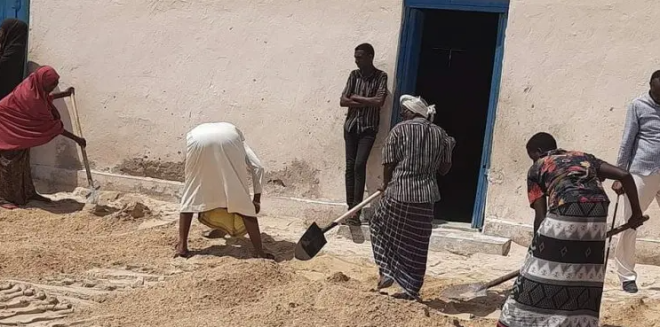
Local volunteers at work clearing the sand blocking roads Central Somalia/File Photo/Ergo
Hundreds of pastoralist and fishing families in Kulub village in central Somalia’s Mudug region are facing deepening hardship after massive sand encroachment forced them to abandon their homes.
The community, now scattered across exposed open land on the outskirts of Kulub, lack proper shelter, water, and access to other essential services.
Ahmed Abdullahi, 52, a father of 10, says he no longer recognises the place he has lived his entire life.
“Our life has really fallen apart. We cannot even afford to cook regularly. We have nothing left from the little money we used to earn. I looked for work in Garad several times, even simple labour, but I couldn’t find anything,” he told Radio Ergo’s local reporter.
Coinciding with their forced displacement by the sand dunes, local communities depending on fishing have suffered income loss because of a ban on lobster catching by the authorities imposed in August.
Additionally, the season of high tides and windy weather means that the amount of fish being caught by local fishing crews has decreased dramatically.
Ahmed’s family now lives in a makeshift shelter made of iron sheets on open ground. They miss their own two stone-built rooms, with a kitchen and a latrine, that was buried by the sand.
He recalls how the family fled after the sand pressed through the outer wall and began causing the house to collapse.
“The sand came with very strong winds, it buried the fence and filled our water reservoir. We tried to push it back but we couldn’t. When it broke one of the room walls, we feared the house would fall in on us at night. That’s when we escaped,” he said.
The closure of the local school has been one of the biggest blows to his family. Eight of Ahmed’s children were attending classes when the school was forced to close in May. He paid a total of$20 a month for their schooling. In nearby areas, fees range upwards from $10 per child.
“I worry a lot, if they don’t learn, their whole future is affected. But I can’t pay and there is simply no school left in our area,” he stated.
Said Hassan Yusuf, a father of nine, also fled after the sand destroyed the wells that the community relied on. Today, the only water he can access is trucked from Garad at a cost far beyond his means.
“The wells we used are all buried, a water truck comes from 35 kilometres away because the old routes are blocked by sand. We can’t afford that, so we take water on credit, or beg for help from relatives,” he said.
Two of the main access roads to Kulub village are now closed due to the sand dunes. Residents attempted several times to reopen the road, but strong winds quickly blew sand to fill the paths they had cleared.
The blocked roads have stranded water trucks and cut off supply lines for essential goods.
Kulub had a functional health centre run by international NGO, Save the Children, providing vaccination services, basic medicines, and maternal health care. The facility is now buried. Said says this has already had fatal consequences.
“Even fever medicine isn’t available. Two people have died so far, a woman who was in labour who bled to death, and an elderly man who couldn’t get even a pain-relief tablet. We had nowhere to take them,” he told Radio Ergo.
The collapse of livelihoods has pushed these families further into destitution. Said, a pastoralist, lost 30 of his 50 goats to the drought that struck the area following low rainfall in two consecutive seasons. The remaining animals are too weak for sale, lacking both grazing land and water.
Kulub village chairman, Abdi Yusuf, confirms that sand encroachment has now reached every part of the settlement, turning it into an uninhabitable space. He says the crisis has been growing since 2012 but has accelerated significantly recently, overwhelming the ability of residents to respond.
“People have lost everything, shelter, schools, health services, even the roads,” he said. “They moved to the outskirts with nothing, their shelters that cannot protect them from the sun. Their livestock are gone and fishing has stopped. They have no income at all.”
Abdi added that the local administration had forwarded the issue to the Puntland authorities without response. He fears the advancing sand will soon displace families again from the little space they have left.
“If this sand is not controlled, it will move further and force people out of the areas where they are now temporarily staying,” he warns.
For the families of Kulub, the struggle is not only about displacement but also about the disappearance of the very foundations of community life – water, health care, education, income, and security.