
Thursday, February 01, 2007
Jendayi Frazer also told the business daily that it was going to be a while before it could be confirmed who had survived the Ethiopian invasion of Somalia in December, and the subsequent US air strikes in the country, and who had not.
"It is going to take some time for the fog of war to clear up and we have an ability to see who is still operating and how they are operating," she was quoted as saying by the FT.
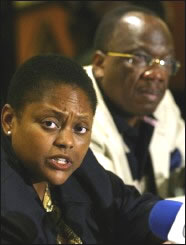 Speaking from Addis Ababa, she did say, however, that she was "very concerned" that elements of the defeated Islamists were "trying to reconstitute themselves either out of Saudi Arabia or Eritrea."
"We have to engage with the Saudi government and their services to try to prevent that from happening as well as engage regionally."
Frazer also said that Eritrea was a "source of regional instability."
"Eventually Eritrea will see the limits of its actions to destabilise the Horn" of Africa, she said.
Ethiopian Foreign Minister Seyoum Mesfin said on Wednesday that a long-awaited 8,000-strong African Union peacekeeping force would be deployed to Somalia within a month, thus avoiding a security vacuum there.
The force is meant to take over from Ethiopian troops who entered Somalia in December and helped a weak transitional government, which had been previously confined to a provincial backwater, topple hardline Islamists who had been running the capital Mogadishu for the previous six months.
Somalia has been the scene of a near endless cycle of violence since the toppling of dictator Mohamad Siad Barre in 1991 but key international players have said recent events provide a window of opportunity to restore stability.
Source: AFP, Feb 01, 2007