Addis Ababa sending troops as advisers to UN-sanctioned interim government
Wednesday, October 25, 2006
ESTANISLAO OZIEWICZ
 Ethiopia upped the ante with the Islamist rulers of Somalia's capital yesterday, saying it is on the edge of war following their repeated declarations of jihad against Addis Ababa.
This is not just a rhetorical conflict. The United Nations and some analysts fear that a vicious shooting war could erupt between the neighbouring rivals that would enflame the entire Horn of Africa.
There has long been bad blood between Ethiopia and Somalia, which share a long and porous border. The current hostility is particularly worrisome because Osama bin Laden has called for the region to become the world's third jihadist front after Iraq and Afghanistan.
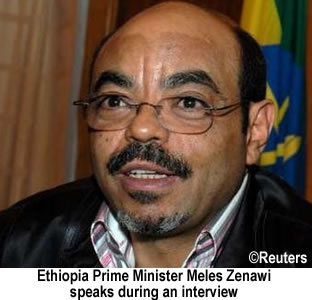
Meanwhile, Ethiopian Prime Minister Meles Zenawi acknowledged for the first time that it had sent "several hundred" armed military advisers across the border to help Somalia's enfeebled and dysfunctional UN-recognized transitional government, based in the town of Baidoa.
He also told Reuters in an interview that his country is "technically" at war with Somalia's Islamists, who, according to various news reports, control most of central and southern Somalia.
"The jihadist elements within the Islamic Court movement are spoiling for a fight," Mr. Meles said. "They've been declaring jihad against Ethiopia almost every other week. Technically, we are at war."
But Mr. Meles said that his forces, among the biggest and best equipped in Africa, would fight only if they are attacked.
"We believe they've been preparing terrorist outrages," he said. "They're very close to our border. The indications are not that encouraging. But we've been patient so far and we'll continue to be patient.
"We are trying to avoid a shooting war to the maximum extent possible and therefore, as it were, we are looking the other way. They will have to force us to fight. That can come when and if they physically attack us."
The Brussels-based International Crisis Group, worried about an accelerating drift toward war, is urging the Islamic Courts Union and the transitional government to resume dialogue.
The group wants Ethiopia to stop all military interference in Somalia and what it calls inflammatory rhetoric.
Some estimates place Somalia's population at nine million, but the figure is suspect because the country has not had a functioning administration for more than a decade. Ethiopia has about 75 million residents.
The crisis group says that the roots of the current situation are related more to power, prestige and Somali clan issues than to ideology. At its core, the group says, is the transitional government's failure to make itself a genuine government of unity and the emergence of the Islamic Courts Union "as a platform of opposition from large sections of the Hawiye clan -- probably the largest, most powerful kinship group in southern Somalia."
The transitional government of Somalia is a creature of the African Union and the United Nations and was formed in 2004 in hopes of bringing a semblance of order after 14 years of state collapse and two years of peace talks.
In a recent report, the International Crisis Group said the standoff between the transitional government and its Ethiopian ally and the Islamists threatens to escalate into a much wider conflict "that would consume much of the south, destabilize peaceful territories . . . and possibly involve terrorist attacks in neighbouring countries."
The UN's World Food Program said that at least 240,000 Somali refugees are in Kenyan camps and more are arriving every day.
Source: The Globe and Mail, Oct. 25, 2006